Related Posts Plugin for WordPress, Blogger...
Showing posts with label Music. Show all posts

Saturday, 8 January 2011

Diaghilev and the Golden Age of the Ballets Russes


Diaghilev and the Golden Age of the Ballets Russe was a magnificent and extensive exhibition in a way that will make it impossible to try to write about it all in a contained blog post. The exhibition is a feat which the V&A have pulled off with an elegance akin to the Ballets of Diaghilev. But I do not know much about Ballet so I will have to approach this in my own way.

First of all I will give you the V&A's introduction as a preface;

'Serge Pavlovich Diaghilev, dictator, devil, charlatan, sorceror, charmer- all names of a single man whose unique character and driving ambition caused a ferment in European culture. He embraced the modern and exploited the avant-garde, but was in many ways deeply conservative. He lived mostly in hotel rooms, but turned his company into an extended family.'

The Ballets of Diaghilev have left behind them a legacy of opulent relics; costumes of extreme fantasy, epics of scenery, programmes, posters, choreography, with colour and influence coming from all cultures across the world. I am sure that each visitor comes to this show with their own particular interests in my mind, drawn to particular elements and not others. It is this focus which I will use to write something coherent with. My interest was as an artist; Costume sketches, the graphic design of posters, prints and art works inspired by the ballet all collated to form the kind of wild sketchbook every artist wishes to claim. The ballet dancers called to be drawn, even choreographic plans formed patterns that looked like constellations. Artists inspired and involved with the Ballet were names such as Aubrey Beardsley, Georges Barbier, Leon Bakst, Jean Cocteau, Giorgio de Chirico and even Picasso!


Picasso designed the scenery for Le Train Bleu, which was a very happy surprise for me. I managed to take some sneaky photographs of Picasso performing new and unexpected tricks. This curtain towered above me as the two women hold hands and dance across the beach and the strange cubist forms of the set pieces rose up out of the ground. Diaghilev's Ballets were involved with contemporary art culture,;Picasso's contribution was strengthened by the costumes of Coco Chanel and the writing of Jean Cocteau. The ballets are creatures of fantasy but also of a cultural reality.


A failed photograph of some costumes, I got caught.

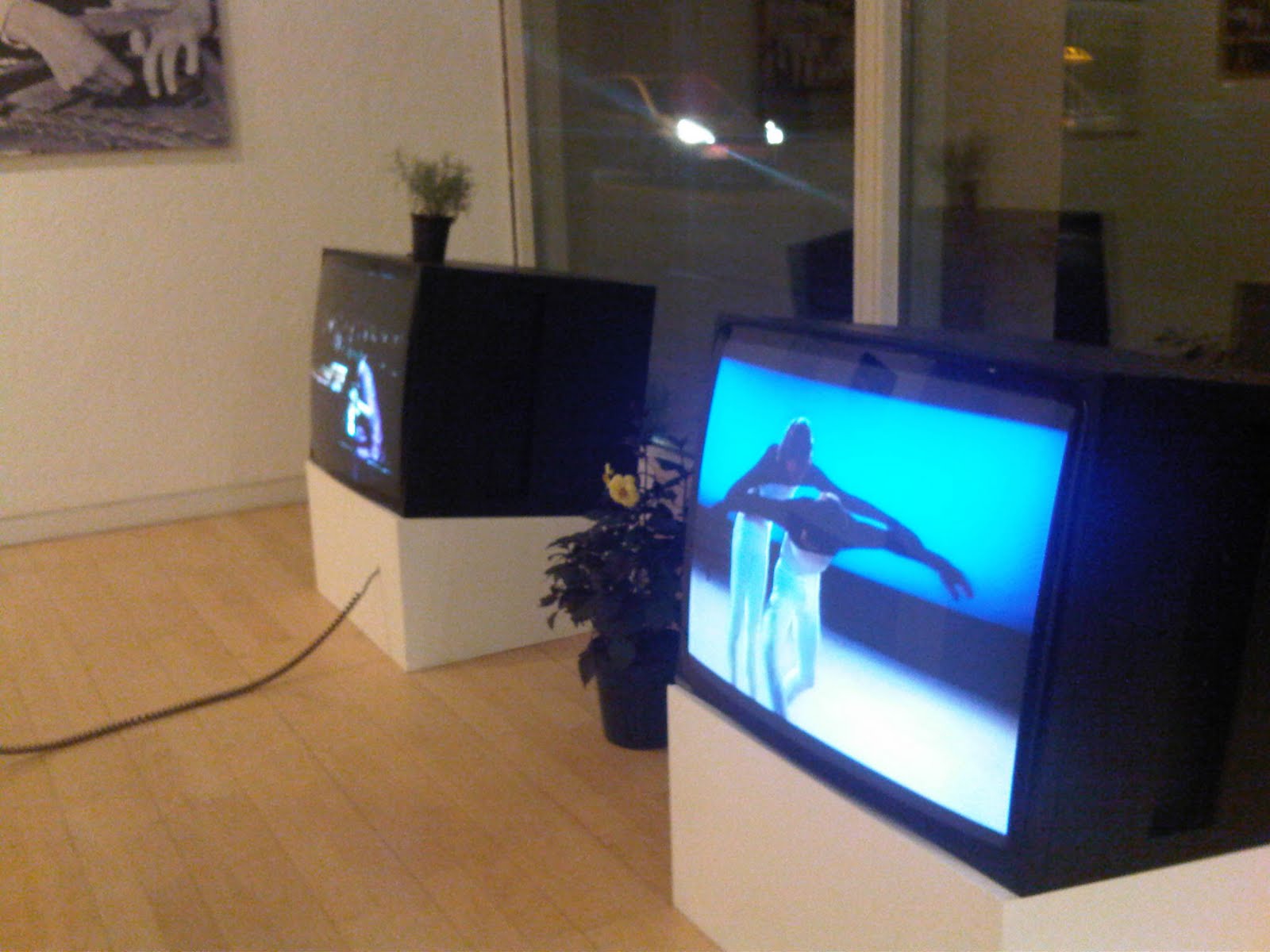
Stravinsky's Firebird Symphony and The Rite of Spring were commissions for Diaghilev (you probably know this, I am ignorant about these things) so I got to enjoy the layered rhythms of the composer as I watched a projection of giant ballet dancers skit across the red-glow of an exhibition hall. Ever since I saw my friend Catherine perform the Firebird symphony at a concert I have been captivated. When The Rite of Spring was first performed it caused a riot as it urged its audience in to chaotic frenzy. I feel something of this in the dark room with the projections.


I also made a discovery in the form of Russian Cubo-futurist artist Natalia Goncharova. Taking her inspiration from folk art, russian identity and traditional fairytales, Goncharova's sets were a labyrinth of the magical peaks of Russian architecture which I have loved since I was a child.

This post barely does it all justice, so go before it ends!

Friday, 17 December 2010

Cage against the machine

Last year in the UK hundreds of thousands of people raged against the machine that is the X-Factor and bought Rage Against the Machine's song of rebellion, in defiance of powerful musical institutions. We got it to Christmas number one and suddenly everybody felt the power of the people, the power of Facebook to spread the messages of real people. This year there is a whole collection of similar campaigns, but I don't believe that any have the power to succeed. Raging against the machine was about fighting repetition and monotony and the predictability of the British music industry. If every year there is a facebook campaign then all we succeed in doing is initiating a new kind of predictability; we produce a new mould for music to be forced in to. However in the light of a recent Kettles Yard exhibition there is one campaign which interests me; Cage against the machine http://www.facebook.com/cageagainstthemachine.

John Cage's '4'33' is a composition of four minutes and 33 seconds of silence. The statement is inherent. We would rather listen to silence than your manufactured rubbish. But paying 79p for a track of complete silence on Itunes, is definitely not the point. It is an absolute waste. Cage's composition is a performance piece in which the audience are given a unique opportunity to experience silence and to consider their experience of this. When Cage's composition is a track on your itunes which can be skipped or that passes by as an unnoticed interruption, it loses all meaning and effect. This is how 4'33 should be experienced, and you can't recreate this in your bedroom;


The campaign also annoys me because I'm sure for many people Cage is unknown or obscure. I don't think his silent composition heard in isolation is a representative introduction to the artist. So here are some real reasons to be interested in Cage.

Not Wanting to say Anything about Marcel, Lithograph 1969


Mushroom Book, Plate X, 1972


River Rocks and Smoke 4/11/90 1978 and 17 Drawings by Thoreau 1978

Hopefully this introduces the expansive stretch of Cage's work,;encompassing music, film, painting and printing. At one moment cage has the precision of a printer, the chaos of mapping ideas and feelings and the next is free in his abstraction. With lyricism and musical sense in all that he does, if you are going to Cage against the machine, make sure you understand what it's all about.

Monday, 15 November 2010

Every day is a good day


On Saturday my mother came to visit. We had lunch, shopped and then sipped pur takeaway coffees as we made our way across Jesus Green in the pink sunset for the last fading minutes of the John Cage exhibition at Kettles Yard. I have been meaning to get this exhibition all term and finally arrived, with my mother in tow. I made it a day before it finished, to realise that it was brilliant and that the 20 minutes we got before closing were never going to be enough to listen to all the recordings, watch all the footage of Operas in performance and enjoy the highlight of the exhibition and place a plant.


I enjoyed the plants a lot. As you enter the exhibition the curious network of potted plants pave the exhibition floor and they are what strike you and endow the space with a homely feel. You can pick up a plant and place it anywhere you like in the exhibition. Audience participation and exhibition interaction always excite me, I am easily pleased. However as some visitors have pointed out, you can't put your plant anywhere, you are in fact restricted to the floor. The neat position of some of the pots on the fringes of the rooms might also suggest the restrictions on plant-placing freedom. John Cage's prints are beautiful; ethereal, full of movement and subtle qualities, but they almost become peripheral to the plants. Some are accompanied by explanatory notes, 'This plant is definitely not happy here, it would like to be on the ceiling.'. The suggestion is that the plants direct and not visitors, that we might think we are contributing, but ultimately the artist is directing us.
My mother was unimpressed by the plants, she says she is too old for that kind of thing, she has seen it too often!

A plant cheekily nestled in a pair of head phones!

Friday, 29 October 2010

Cambridge Zoology Museum- Bonesong (New Student Opera)


http://www.facebook.com/event.php?eid=163717650322231&index=1
I knew this would sell out, I could sense it. The 400 confirmed facebook guests may have had something to do with my instinct...but anxiety dreams and predictions aside I was going to go to the Zoology museum in the dark and rain, and try.
'in the darks halls of the Museum of Zoology
long after closing time
an underground opera club night.'
It all just sounded too tantalisingly dark, too much like childhood nightmare turned bitter fantasy, to be missed. And the papers just kept going on and on about it, clearly, a little bit too much. Capacity was 195 people and with 'guestlist' VIPS continually ushered to the front it became clear that hundreds of people were going to be turned away.
Oh the ache of being just so close, and yet just so far...
I held out until the very last second of orchestral tuning, the colossal skeleton of a Whale illuminated above my head as consolation. As people began peeling away one man in blue overalls could be distantly heard suggesting an alternative viewpoint. With £3 still in my purse I walked around the side of the building, up some concrete stairs. Now level with the mammoth whale, I pressed my face up against the glass and looked down upon a flickering collage of projections. I felt like a child from my birds-eye-view, lusting after things which are faraway and adult. One day... I felt a kind of triumph countered with the stabs of jealousy I recognised as I saw people I knew down below, with programmes, friends and drinks from the bar.

Another kind of Opera was witnessed up here; it was communal and participatory as we huddled against the cold, vast window panes and partly imagined the story. Were they singing in English? All was unintelligible. In the soft musical interludes and the moments of quiet, subtle anticipation we heard only the silence of expectation fogging up the glass. It became a mime, with brief glimpses of Opera appearing from between the animal skeletons and specimen cases...at the end we decided, it must have been good, they are clapping a lot, and walked away in to the empty streets, half-satiated, knowing that we had made a valiant effort to witness something vibrant and new.