Related Posts Plugin for WordPress, Blogger...
Showing posts with label London. Show all posts

Monday, 2 January 2012

The Peripatetic School: Itinerant drawing from Latin America

Ishmael Randall Weeks, Fragments 2011, Mixed Media Installation


The Drawing Room is a small gallery stranded in Bermondsey (although the opening of the new White Cube might suggest it won't be stranded for long). It is a 15 minute walk from the tube station through suburbs and housing estates, but you must not let doubt creep in. When I eventually find it, the converted Drawing Room factory stands in the deserted centre of an industrial complex, it seems to have no entrance. I circle the building in silence and begin to think I have been led to the biggest prank in the art world.


You have to ring a bell and someone will come to let you in. The Drawing Room is the Tate Modern's cooler little brother; subsidiary projects which are far too niche to grace the walls of Gilbert Scott's epic factory, but which, without the support of their rich elder sister would surely die. In ways that other galleries can't, The Drawing Room just gets to have fun, and The Peripatetic School's Latin American artists are the best example of this.


Tony Cruz, Distance Drawing San Juan/ London, an attempt to draw the distance from San Juan to London (6,751.2362m). Realised only 0.0031890 percent (2,153m) 2011, Dibujo Distancia


Latin American art is obsessively peripatetic, concerned with the landscape, both urban and rural and the things we might find in travelling, or the things we might take with us. Brigida Baltar's works Untitled and Sertao's Flora use earth as their primary material; Sertao's grip upon Baltar's artwork is as more than just a place of origins and imagination. Her paintings of the Flora of her home town are delicate, nostalgic earth works.


There is a polemic in this exhibition. Drawing, so frequently the medium of peripheral sketchbook studies, has powerful energy and movement and is used here in challenging ways. Nicholas Paris' Hurry Slowly is a series of drawings and cut-outs of a running man which incorporate a number of found objects; the heel of a shoe, a piece of driftwood, a spirograph. Totems which rest on a shelf below the drawings. Testaments to our attachment to objects, but also their portability, both imaginatively and physically. Each object changes the drawing; it's texture and its mobility. Our sense of the speed at which the figure hurries is modulated by its object.


Mateo Lopez, Nowhere Man 2011, Mixed Media Installation

'Drawing has always been the most portable medium' claims the exhibition blurb. Tony Cruz's Distance Drawing, a pencil drawing made directly onto the wall of the old factory, is like the automatic scribblings of a seismograph. It feels like the obsessive scribblings of an artist desperate to record; and yet its obvious portability destroys the illusion. How many times will the unfinished drawing be reproduced, and how is it transported between galleries, from wall to wall?

The installations of Mateo Lopez and Ishmael Randall Weeks look as though they could be packed up and carried away. Lopez's Nowhere Man is a temporary home with desk drawers filled with maps, and more suggestive materials scattered about than can be processed in a single viewing. But the overall sense is of its emptiness. Randall Weeks' Fragments is my pick of the whole exhibition; an architect's table of sketches and plans, towards a Utopia? But once again it has been abandoned, stranded in Bermondsey.


You might arrive to find the space empty, but treasure it all the more. The Drawing Room is doing really exciting things with its factory. The Peripatetic School is an intellectually engaging exhibition. The white bricks walls like blank paper, let these displaced drawings speak for themselves, and what they have to say is filled with energy and itinerant creativity.


The exhibition will be at Mima in Middlesborough until the 12th February 2012.


Friday, 4 February 2011

Shadow Catchers

I know that this is an old post but today I am at a symposium at the V&A which ties in with the exhibition. So I shall refresh my own and your memory, in preparation for what will hopefully be an inspired post later in the week. The artists will be talking a long with somewhat of an idol of mine, Marina Warner. No work for me tomorrow just shadowy play!

Floris Neususs

Everybody has a camera now, everybody can take high-quality photographs without laying claim to any particular 'skill'. The artist's visual eye can be replicated with photo-editing tools and auto-correction. To take a beautiful photograph is no longer enough. So the question is where does photography go next? How will it adapt to survive?
The brilliance of the V&A's exhibition 'Shadow Catchers' is that it provides an answer to this question without necessarily meaning to. Not everybody can conjure beauty in to being out of a seeming nothing. I was genuinely captivated, awed, astounded (so much so that I require multiple adverbs) by these images and the revelation of the possibilities and processes available to the contemporary photographer.

Floris Neususs appeared to have emerged from the Cottingley fairy generation with his lifesize photograms of women. These Body-grams appear to have captured women in flight; here they are dancing with faint shadows of birds and moths or curled up vulnerably like netted butterflies. Neususs has taken that darkroom experiment, the photogram, and given it a larger-than-life ethereality. 'Be Right Back' has fixed the shadow of a woman beneath a now empty chair; the human trace we leave behind, the haunting beauty of a ghost narrated. In Untitled Kassel some parts of the work remain unfixed so that colour changes over time. Neususs is interested in the transience of his medium, the sense of preserving the absent and nurturing the human sense of emptiness.

Susan Derges

Photography has always harboured an interdependence with the natural world and camera-less photography engages with deep underground natural processes. Neususs leaves photo paper in the garden at night to be exposed by lightning; light appears to have scanned the paper leaving shockwaves and scars. Garry Fabian Miller's interest is botanical; photography, like photosynthesis, is about light. Translating plants and leaves to photographic paper these are precise botanical illustrations which track growth and decay. He describes his interest in light and time as the 'accumulation of days'. Susan Derges's element is water; her photograms map the water's surface, the flow of rivers, it's undercurrents and secret shifts. She creates 'sun prints' by placing her photographic paper beneath the water to be exposed by sunlight, revealing 'what underlies the visible', the 'absent moments' which until now we have only been able to imagine.

Pierre Cordier

Which leads on to the power to create and regenerate; the otherworldly. Pierre Cordier's use of the chemigram has enabled the patterning of geometries, labyrinthine formations, the emergence of strange new worlds. He describes his work as 'a mutation, hybrid and marginal- fake photographs of an imaginary, improbable and inaccessible world.' What is captured are shifting forms that offer strange glimpses of space and new dimensions. As Fabian Miller develops he moves towards more abstract images, his photo a day project is a portfolio of burning rings of light, new planets emerging. He says they are 'of something as yet unseen, which may only exist on the paper surface.'

Garry Fabian Miller

Adam Fuss's work is a combination of birth and death. His cibachrome photogram 'Invocation' is a halo of light in which a baby is baptised, the tail of a snake wriggles across the paper in another. Fuss likes to work with live animals, with symbols and ideas. But at the other end of the spectrum the My Ghost series shows a figure emerging/disappearing in smoke, a christening gown which has become a spectral shroud.

Adam Fuss

Camera-less Photography is engaged with themes of mortality; with what it can create and imagine but also with those absent, dead things it holds to the light. The Frankenstein's monster of the art world, with a little sensitivity it has the power to be truly beautiful. In those dark rooms at the V&A only the light of these images remains burned on to our retinas with the force of revelation.
I did a few experimental photograms, along with research in to the development of the process by Man Ray for my A-levels, but this exhibition makes me want to get back in to the dark room. Perhaps this is where the darkroom revival begins.

Friday, 28 January 2011

Le Corbusier's City of Tomorrow

Walking the city has somehow wandered in to the realms of town planning in my second dissertation. In 1924 Le Corbusier published The City of Tomorrow, an architectural polemic against the modern city and proposing a new Contemporary city. I love Le Corbusier's book because of its scrapbook quality; architectural plans are combined with photographs, aerial views of towns and sketches.
‘A TOWN is a tool.
Towns no longer fulfil this function. They are ineffectual; they use up our bodies, they thwart our souls. The lack of order to be found everywhere in them offends us; their degradation wounds our self-esteem and humiliates our sense of dignity. They are not worthy of the age; they are no longer worthy of us.’

As the world was changing; with war, industry, and traffic, architects and town planners believed that the city needed changing too.

New York :Congestion, a damning condemnation.

Hausmann's restructuring of Paris meant that it was the ideal space for new plans and aesthetic debates. Corbusier wants the city to combine green space with functional, efficient networks of labour.


But Corbusier's city appears to me to be just another kind of a machine, with skyscrapers that 'thwart our souls' and our green spaces by looming above them. The women in my dissertation walk the city, map human emotion upon it and react against such drastic destruction and restructuring. After all isn't human emotion more like the labyrinthine palimpsest of London than the open boulevards of Paris?


Leonora Carrington- Labyrinth

Tuesday, 25 January 2011

Jessie Dismorr- Vorticist Streets

At the end of last year, blindly searching through obscure art and literature magazines in the University Library, I made a discovery. Jessie Dismorr. I absorbed every contribution she made to Wyndham Lewis's Vorticist magazine, Blast!, and decided that I wanted to write about women walking in London and that I wanted to write about Dismorr. She brought me the revelation of my dissertation. Six months later and I am still clinging to Jessie but I have found nothing more of her than my first fruitless trip to the library had to offer.

Vorticism was a British avant-garde movement which was formed in 1914. It's manifesto stated that 'The New Vortex plunges to the heart of the present! We produce a new living abstraction!' and it aimed to 'blast' contemporary art by revolutionising it. Interested in the aesthetic of machines Vorticist paintings were about bold lines, striking contrast and powerful abstract shapes. (In June of this year the Tate will open an exhibition of Vorticist work!)

Contribution to Blast! The Engine

A largely neglected Vorticist artist, Dismorr was one of the 'little lapdogs who wanted to be Lewis's slaves and do everything for him' (Kate Lechmere), there was only one other Lapdog, Helen Saunders. There were only two female Vorticists; as a woman Dismorr's contributions and notoriety are limited. There are a few details which keep repeating in my searches; one is that she once stripped naked in the middle of Oxford Street. This makes me love her a lot.

But it is Dismorr's experience of London which really interests me. In a small vignette called June Night she writes of a bus journey with a man called Rodengo who is 'too conspicuous for daylight'. Dismorr escapes the 'unmannerly throbbing vehicle' of the bus to 'take refuge in mews and by-ways'. Her experience of this sudden night-time freedom in the streets is exciting and surreal;

'I wander in the precincts stately urban houses. Moonlight carves them in purity. The presence of these great and rectangular personalities is a medicine. They are the children of collossal restraint, they are the last words of prose. (Poetics your day is over!) In admiring them I have put myself on the side of all the severities. I seek the profoundest teaching of the inanimate. I feel the emotion of related shapes. Oh, discipline of ordered pilasters and porticoes.'


Abstract Composition, 1915

I know that she made contributions to Blast! magazine, and to Axis and Rhythm magazine. I also know that I am not the only person interested in her, but I can count the others on my hand. The first is a man named Quentin Stevenson who is writing a biography of her (which has not yet emerged). The second, Catherine Heathcock who wrote an unpublished PHD thesis on her and has the holy grail, the catalogue of all her work, (my supervisor wants me to write my own catalogue but as an undergraduate I am floundering). And finally, a journalist named Mark Archer, who is the only reason I know about any of these other people because he has made his own desperate pilgrimage for knowledge about Dismorr and has covered all of the tracks that I must now cover. My only problem is that I don't know any magical tricks for finding the email addresses of biographers, former PHD students at unidentified universities and journalists at the FT. So in part this is a kind of appeal, for help!

Here is a brilliant article, and the most information you will find written about Dismorr on the entire internet.

Thursday, 6 January 2011

The Museum of Everything

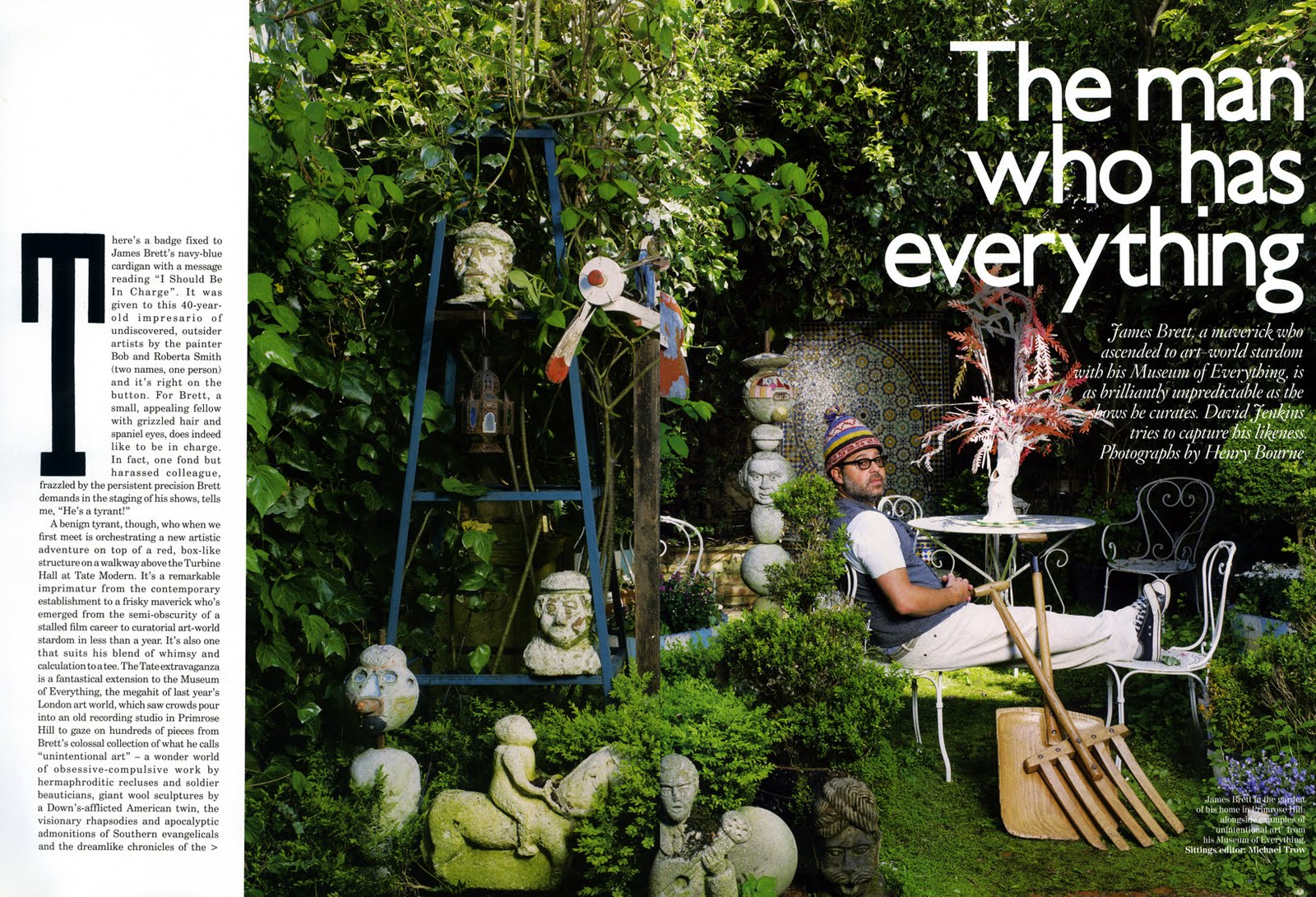
When I come back home I am afforded the luxury of old issues of Vogue. Like a magpie I always plunder them with new ideas in my mind; sometimes I am just seeking out Tim Walker's photoshoots and other times all I want are bright adverts to use as chic wrapping paper. This time I discovered an article that I had missed, about a man named James Brett, who has the potential to become something of an idol.


Last year Brett brought his collection of 'unintentional art', The Museum of Everything, to an old recording studio in Primrose hill. (And a little research has just revealed that it has returned to Primose Hill, as of January 5th! Yes!) Arising from what he describes as a 'compulsive nature' Brett's curatorial method is to collect together found objects, artefacts, the things which interest him rather than what the art world sanctions as valuable. As a bit of a magpie myself (and a penniless one at that) the sentiment definitely appeals. The Museum showcases the art of 'untrained individuals, the socially marginalised and psychologically fragile.' Brett sounds like the most successful art therapist on the planet, orchestrating a huge social experiment. Branded 'Outsider Art', The Museum of Everything has been hailed as a breath of fresh air in the art world.


The website urges us to 'Marvel at our assemblies of Punch and Judy and little people! Bedazzle yourself with side-show banners from the Americas! Ride the miniature fairgrounds of retired Norfolk farmer Arthur Windley! Stuff yourself at Walter Potter's Museum of Curiosity, a masterwork of Victorian animalia!' It sounds like just the kind of surreal treat the world needs.


'I like the idea of a Radio 1 kind of roadshow, take it round the country. The Antiques Roadshow on acid- with soup!' James Brett.


So be careful what you wish for, it might be coming to a town or a country near you.


Friday, 24 December 2010

The Eric Gill Pilgrimage

The Eric Gill pilgrimage turned out to be providential. I had planned out my landmarks but was unaware how close they were together; Oxford Circus, Victoria and South Kensington formed a tightly bound prism on the tube map. Then there was the Itsu (www.itsu.com) opposite Portland Place which provided the perfect lunch and the unexpected Gill sculptures which greeted me as I entered the V&A. When I emerged from the underground at Oxford Circus I could already see the beacon of broadcasting house beckoning from just behind the lines of Christmas shoppers.

In 1932 Gill produced the Prospero and Ariel sculptures which still furnish the exterior of BBC broadcasting house. The BBC chose Shakespeare's The Tempest as a theme in order to make a cultural statement. Prospero was an 'airy' spirit who represented the airwaves of broadcasting. However Gill adapted the sculpture to his own beliefs about culture. And so Prospero and Ariel become God the Father and God the Son. When I arrive at broadcasting house in the flesh all I can see is Eric Gill's big joke on the BBC.

I assume that Gill's sculptures are details hardly noticed as commuters, businessmen and shoppers pass them by. However they are beautiful. I particularly like the detail of the wave that rides the building round as a trimming. I have seen so many photographs of these recently that I don't know what it means to have a set of my own, whether it will mean anything? Nevertheless I get in to the road and flutter about the steps of Langham church making a fool of myself with my camera.
‘Had not Prospero power over the immortal gods? At any rate it seemed to be only right and proper that I should see the matter in as bright a light as possible and so I took it upon me to portray God the father and God the son. For even if that were not Shakespeare’s meaning it ought to be the BBC’s’ Eric Gill
For Eric Gill the light of religion illuminates all creation.

My second stop, and what I assumed was my final, in the short pilgrimage was Westminster Cathedral. In the bitter cold as Christmas is nearing The Stations of the Cross with a little Catholic liturgy thrown in for good measure, seemed satisfyingly appropriate (probably more suited to Easter, but as a heathen I only have a gentle feel for these things). As a raging Catholic sculptor, although relatively unheard of at the time, Gill was asked to furnish the Cathedral's pillars with carvings of the Fourteen stations of the cross. This is Gill's 'Epic' just as The Anathemata is David Jones's; it communicates the whole history of a people and culture even if this history is uniquely that of Religion and the Passion. Mounted on pillars in Westminster these succeed in being epic.

Only one photo for you as the angles were awkward, although I did get some beautiful postcards so perhaps I will share those as a treat eventually. Red lettering and Gold details add subtle decoration, to a stark but beautifully conceived sculpture.
The final joy of the day was arriving at the V&A believing I had, had my warm cosy fill of Gill, only to be confronted by a preparatory carving for Prospero and Ariel in an alcove. I had unwittingly stumbled upon a new landmark in my pilgrimage.

To supplement my endless reading on lettering and typography there were framed tablets of Gill's typefaces. He donated them so that they could be studied by the V&A's legacy. You have no idea how often I have consulted black and white reproductions of these, now I am the student poring over them.

Gill's sculpture Mankind is a female cipher for the power of his sculpting. She is a luxurious decapitated monument to sexuality and the sensuality of stone. Gill admired tradition with such fervour but he commands a space in the centre of it all. I spent a long, long time absorbing buttocks, indents, curves and Gill's own deep admiration of the female form. Here she is for your enjoyment.

You can deny Eric Gill many things, but not this appreciation. In the V&A Fiona McCarthy's biographical revelations are irrelevancies, Eric Gill is a modern British sculptor whose influence stretches across the exhibition hall from Robert Gibbings to the student of lettering.

Thursday, 23 December 2010

Magic Lantern- Mat Collishaw


I have to admit to not knowing what I expected. Perhaps I was just looking for some of the beauty that had entranced me in his Insecticide prints. In which case I can't deny that Collishaw delivered. I think perhaps I imagined that Collishaw had been granted the dome of the Victoria and Albert museum as an exhibition space. Well this is also true, but we are not as yet granted access.
At dusk I ask how I get to the dome and I am told that I will have to go out in to the street to see it. If I cross over the road I should get the best view. So I wrap up warm and dash across the road, the dome has been transformed in to a beacon of light but I am too close to discern its detail. So I skip down the street passing tall South Kensington doors and parked black taxis until I can look back and take it all in.
In the street in my madness Collishaw's Magic Lantern looks like a schizophrenic strobing of bats in the belfry, not the elegant worship of moths to a flame. But I have to put this down to my obscure perspective. I don't think that this mad dash outside as closing time approaches at the V&A is what the experience is about. This is for the outside world; a beacon to lost souls out in London who might be attracted to the Victoria and Albert museum like little moths to its potent art flame.
I have committed another injustice. When I return to the Madejski gardens to see the replica zoetrope I can gain enough perspective to feel real admiration. Here the moths are engaged in their ritual worship of the light. Delicate, fluttering forms moving faster than the eye can perceive. A zoetrope is a cylindrical device first designed in 1834, 'a rapid succession of images simulates motion'. As with Insecticide I see Collishaw playing with the modern and the traditional; digital animation and Gothic fairytale are forced together in a contemporary fusion. When Collishaw's zoetrope begins to spin on the edge of the lake magic is invoked. I wish I could get far enough away from the dome to see Collishaw 'animating the Museum's architecture with a work of haunting beauty.' For now the replica zoetrope allows me to imagine and my imagination goes wild.

Thursday, 8 July 2010

Paula Rego: The Oratorio, Marlborough Fine Art, London (7th july-20th August)


Just as it is difficult to write a review of something you know absolutely nothing about, so it is a challenge to write about something you are passionate about. I will attempt to resist the urge to gush about Paula Rego. After years of flicking through her books with a gasp for every page, for every reproduced print or painting this was my first time seeing her work in the flesh. And there is so much flesh about Rego's work that it calls to be seen first hand in a small gallery space where there is no possibility of averting the eye or flicking past the page.

Another Rego fan who asks me to take a picture of him and his nephew in front of the Oratorio, the crowning Triptych of the exhibition, says 'Paula doesn't shy away from anything.' but in this exhibition I feel this more than ever. Familiar elements of Rego's work can be glimpsed but the nightmarish undertones have taken over, so that the grotesque figure of the deformed midwife, the woman with wrinkled gourds for breasts who performs the circumcision, are no longer the nightmare in the background but the reality in the foreground.

Rego's work is still folkloric, timeless and placeless but the issues it has swallowed and spat out are not. Female circumcision and abandoned babies, rape and oppression.

Pablo Picasso; The Mediterranean Years (1945-1962), The Gagosian Gallery, London


Picasso is a name everyone will recognise and is therefore an artist who everybody feels they can either dismiss or embrace in ignorant bliss. But there is more to 'Picasso' than swapping a nose for an eye to make an abstract portrait; The Gagosian bursting with sculptures, ceramics, prints and paintings as if it were Picasso's Mediterranean holiday home is proof of this.

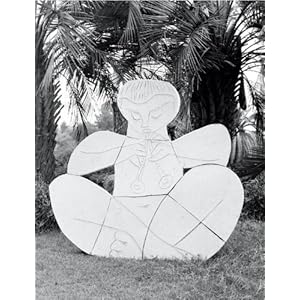
Picasso is a sculptor, this is the revelation the Gagosian gallery held for me. His sunflowers in a vase cast fantastic skeletal shadows on the walls. I wonder if this is an accident of masterful curation and lament the fact that in the dark spaces of the gallery more is not made of the potential for the carnivalesque echoing of sculpture in shadow. Picasso cut-outs are displayed like scenery for the feast of Bacchus- musicians sitting cross-legged, crowned with ivy-leaves. There is a mock Greek vase, Picasso-printed. The sculptures are towering forms of metal and wood. They look as if they have just stepped out of a Picasso painting to find themselves shipwrecked in the white space of the Gagosian gallery, where gallery attendants look more like security guards in an expensive boutique.

Here we find a Mediterranean space in London; the cool white of the gallery space, models, sculptures and ceramics which fill display cases, titles in French, bull-fighting sketches and posters, Picasso's vibrant pallette, his holiday scenes that come straight from a sketchbook left out in the sun. Picasso is a master at turning the every day; a portrait, a scene from the house, in to a dream space, crammed with pattern and surprise. This exhibition is curated to stir the imagination, beyond the spaces of the work. We are transported to Picasso's studio, busy with clay models, works to be fired, prints drying and huge canvases looming above it all unfinished. It is not just about Art, but also artistic practice and an aesthetic way of life.

I see a drawing of Francoise and remember how her beauty, (burgeoning hair, the line of her nose, the almond bud of her eyes) captivated me in Paris in another form. In a painting the children drawing with their mother become the picture they create, great rectangles of blue and green encapsulating and carrying them in to a heady world of artistic inspiration. I have been to many Picasso exhibitions and galleries and arrived at the Gagosian with the anxiety that much of the exhibition would be familiar. But it is refreshingly new. I am surprised by sculptures and ceramic creations. Surprised to find that there is yet more of Picasso to be discovered.

I would like to go and see The War and Peace exhibition in Liverpool, but since I will not make it, The Mediterranean years (the sound of the sea, sand and terracotta villas) will soothe me for now.