Related Posts Plugin for WordPress, Blogger...

Monday, 7 February 2011

Faith and Fabian Miller


Sometimes we come to revelatory conclusions in life, only to realise that they are simple and universal. Recently somebody warned me that everybody needs Faith in something and I can't help asking myself, what do I have Faith in? If it is not God or Love, then what magic word can I attribute to my feeling of Faith and Spirituality in the world?

At the Shadow Catchers Symposium Marina Warner, the intellectual goddess, began the day with a lecture on the histories and contexts of Camera-less photography; phantasmagoria, magic lanterns, silhouettes. This practice was revealed to be steeped in superstitions, it explores the limits of faith and belief by capturing shadows and stealing souls. She showed us the thought projection of Hipolyte Baroduque but told us that the interest of the 'odique clouds' did not lie in the question of their authenticity. Our modern condition is of the 'disbelieving believer' she stated with absolute insight, 'we enjoy without suspending our disbelief'.
She quoted Wallace Stevens, an American modernist poet who I am now desperate to pursue;

'The final belief is to believe in a fiction, which you know to be a fiction, there being nothing else. The exquisite truth is to know that it is a fiction and that you believe in it willingly.'

Marina Warner's words chimed on with growing significance as Philosopher Nigel Warburton interviewed Garry Fabian Miller. 'I was involved with a religious phase, but thank God that's past,' Miller immediately sees the irony but continues, 'Now I'm a free spirit'. Through all the laughter and all the uncomfortable irony, this resonates. Artistic freedom, and also freedom more generally does not reconcile with my idea of religion.

Nigel Warburton christens him a 'photographer of light' but this underplays the sense of spirituality. In his own words, Garry Fabian Miller has made 'a religion out of light', he 'dedicates' himself 'to the light'.


Fabian Miller works alone in complete darkness transforming light in to dark and darkness in to light in an attempt to reach towards the 'white dematerialised end' of the spectrum. Like all artists he seeks that indefinable spirituality which belongs to our work and our passion for it. 'It is your work in life that is the ultimate seduction', wrote Picasso, it is also the ultimate, all-consuming religion. This is why the Symposium was so brilliant; I had not conceived these things at the exhibition. I had not comprehended what a claim was being made about faith and contemplative art practice.

'The pictures I make are of nothing which exists in the world . . . What I am trying to suggest is a state of mind which lifts the spirits and gives strength and some kind of clarity.’_ Garry Fabian Miller, 2003


And yet his pictures are also of the plants in his garden, his walks on Dartmoor. However abstract these things become their presence remains as a shadow. If Miller has created a religion in his art it is the religion of the local and the particular. It describes the power of the local to lift us in to the sublimely spiritual. The meditation of light on a leaf or the water of Dartmoor become abstract constellations, planetary formations and orbits of light. These small things become our universe. I look in to these works of light and I willingly believe Garry Fabian Miller's fiction.

There is a kind of Faith which rests in the beauty of the world as it is. A courageous Faith perhaps? Which looks no further than the magic of leaves dancing in the wind, the natural lights of the stormy sky and the secret rhythms of water. This is my Faith; art looks at the world through a filter, which sees beyond the visible to the sublime. A sublime which already exists in the world but that is beyond the visible eye. Looking on the world with my eyes in light I know that if there is nothing more, this is enough.


Enough, enough now...

Sunday, 6 February 2011

Sunday Selections-Madrid

I'm beginning to enjoy the purely nostalgic qualities of Kim's Sunday Selections which gives me an excuse to idly flick through old photographs and old memories. When I was 16 I spent three weeks with my Aunt and Uncle in Madrid, my aunt worked during the day and so I spent a lot of time exploring the city on my own. I recognise now that this was a huge thing for my sixteen year old self. These photographs are pre-digital camera and they appear to be pre-photography skills, but they have an appropriately dreamy quality. I have on this occasion, indulgently, failed to be selective.


Whilst uploading I began to feel like there was a lot of absence in these photographs, so here is some presence. When I was younger I didn't want people in my photographs, I wanted attractions and monuments unpolluted by crowds, clean lines and light. I think this isn't always true now, people add character.

I'm not sure I ever knew that I would be writing about being 16 and in Madrid so distantly.

Saturday, 5 February 2011

Susan Derges- Dream Landscapes


When my first medieval dream supervision came to an end I was brave enough to ask my supervisor, James Wade, about the prints I had been distractedly glancing at as we discussed the Kingis Quair. He called these etchings of beach and sea 'a kind of dream landscape'. Ever since then I have been searching for my own anachronistic dream landscape with which to approach some of the difficulties of the medieval dream. One of the artist's from the Shadow Catchers symposium, who produces photograms by exposing photosensitive paper beneath the surface of water, has gifted me with connections and openings.

Susan Derges' obsession with drawing the moon and its cycles in to her work points towards a medieval conception of the importance of the heavenly spheres ascending in intensifying circles. 'The moon was just always there in my work' it is an inherent part of her artistic and spiritual practice. In medieval cosmology the moon formed the border between the unchanging aetherial regions and the changeable nature below, in many ways it becomes Derges' border land between states of consciousness. Derges cites a connection between her work and the illuminations of Hildegard von Bingen:


A.C Spearing, author of medieval dream poetry, explains the long inductions to dreams as an attempt to negotiate 'being and non-being'. Comparing it to Gothic Architecture which 'cannot simply stop, it has to fade away' in curves and spikes 'by which the physical presence is gradually withdrawn and the dense material mass is dissolved into the empty air.' The medieval dream has a tendency to dissolve distinctions between narrator and reader and their sense of dream and physical world. It resists definitive ends or beginnings by moving through disorientating layers of consciousness and narrative reality. There is something in Derges too which resists finite ending; the flow of water moves out of reach of the paper, wisps of air rise out of our vision.

These Arches recall illuminated windows as they make the same vibrant, if secular, gesture upwards. The dream is a window on to another world, it offers us a chance to step in to it, however temporarily. It is a mirror of elements of reality which reflects and echoes but also inverts. In Derges' Arches we lose our memory of what comprises the real, tangible element and what is pure fantasy.

Derges' produces much of her work at night, taking prints of the river's flow, she works in the dream-time in an attempt to uncover the things which are beyond the visible. In the same way, the medieval poem uses the dream to escape corporeal restraints and access a higher spiritual knowing; those intangible, invisible concepts. The symposium wasn't an entire distraction, Derges draws me back in to the medieval dream.

Friday, 4 February 2011

Shadow Catchers

I know that this is an old post but today I am at a symposium at the V&A which ties in with the exhibition. So I shall refresh my own and your memory, in preparation for what will hopefully be an inspired post later in the week. The artists will be talking a long with somewhat of an idol of mine, Marina Warner. No work for me tomorrow just shadowy play!

Floris Neususs

Everybody has a camera now, everybody can take high-quality photographs without laying claim to any particular 'skill'. The artist's visual eye can be replicated with photo-editing tools and auto-correction. To take a beautiful photograph is no longer enough. So the question is where does photography go next? How will it adapt to survive?
The brilliance of the V&A's exhibition 'Shadow Catchers' is that it provides an answer to this question without necessarily meaning to. Not everybody can conjure beauty in to being out of a seeming nothing. I was genuinely captivated, awed, astounded (so much so that I require multiple adverbs) by these images and the revelation of the possibilities and processes available to the contemporary photographer.

Floris Neususs appeared to have emerged from the Cottingley fairy generation with his lifesize photograms of women. These Body-grams appear to have captured women in flight; here they are dancing with faint shadows of birds and moths or curled up vulnerably like netted butterflies. Neususs has taken that darkroom experiment, the photogram, and given it a larger-than-life ethereality. 'Be Right Back' has fixed the shadow of a woman beneath a now empty chair; the human trace we leave behind, the haunting beauty of a ghost narrated. In Untitled Kassel some parts of the work remain unfixed so that colour changes over time. Neususs is interested in the transience of his medium, the sense of preserving the absent and nurturing the human sense of emptiness.

Susan Derges

Photography has always harboured an interdependence with the natural world and camera-less photography engages with deep underground natural processes. Neususs leaves photo paper in the garden at night to be exposed by lightning; light appears to have scanned the paper leaving shockwaves and scars. Garry Fabian Miller's interest is botanical; photography, like photosynthesis, is about light. Translating plants and leaves to photographic paper these are precise botanical illustrations which track growth and decay. He describes his interest in light and time as the 'accumulation of days'. Susan Derges's element is water; her photograms map the water's surface, the flow of rivers, it's undercurrents and secret shifts. She creates 'sun prints' by placing her photographic paper beneath the water to be exposed by sunlight, revealing 'what underlies the visible', the 'absent moments' which until now we have only been able to imagine.

Pierre Cordier

Which leads on to the power to create and regenerate; the otherworldly. Pierre Cordier's use of the chemigram has enabled the patterning of geometries, labyrinthine formations, the emergence of strange new worlds. He describes his work as 'a mutation, hybrid and marginal- fake photographs of an imaginary, improbable and inaccessible world.' What is captured are shifting forms that offer strange glimpses of space and new dimensions. As Fabian Miller develops he moves towards more abstract images, his photo a day project is a portfolio of burning rings of light, new planets emerging. He says they are 'of something as yet unseen, which may only exist on the paper surface.'

Garry Fabian Miller

Adam Fuss's work is a combination of birth and death. His cibachrome photogram 'Invocation' is a halo of light in which a baby is baptised, the tail of a snake wriggles across the paper in another. Fuss likes to work with live animals, with symbols and ideas. But at the other end of the spectrum the My Ghost series shows a figure emerging/disappearing in smoke, a christening gown which has become a spectral shroud.

Adam Fuss

Camera-less Photography is engaged with themes of mortality; with what it can create and imagine but also with those absent, dead things it holds to the light. The Frankenstein's monster of the art world, with a little sensitivity it has the power to be truly beautiful. In those dark rooms at the V&A only the light of these images remains burned on to our retinas with the force of revelation.
I did a few experimental photograms, along with research in to the development of the process by Man Ray for my A-levels, but this exhibition makes me want to get back in to the dark room. Perhaps this is where the darkroom revival begins.

Thursday, 3 February 2011

The Turner of the Waves

I love the sea, it is this immense body of water which I am sure so many thousands of people feel a deep, strange affinity with. It's a sensation, as waves roll in and out on the dark beach, that I struggle to put in to words. But when I saw Maggi Hambling's wave paintings I felt I had found an expression. Hambling paints the British sea, the North Sea, the 'raging beast' that 'eats away and is changing our coast forever'. She grapples with its power, with courage and force she paints the sea.


'Good morning, death - Good Morning
Early in the day I draw the sea with graphite in a sketch book. Back in the studio I create waves that break again, in oil paint, bronze or etching ink. People, animals, birds emerge from the subconscious as I work and are there to be discovered.
[...] Terrifying, beautiful, rapacious, embracing, never still, always hungry, always seducing, always mysterious, always there.
As a child I would walk a short way in to the sea, stand still and talk to it, ten-to-the-dozen. Now I listen and identify with the shingle, as the sea, like time, forces inevitable erosion.'
Maggi Hambling, April 2010

I can identify with Hambling's relationship with the sea. When I go to the beach I walk all the way down its long spine at the waves edge, picking up treasures and telling myself stories. There is a kind of walking with your feet in the sea which I find irresistible. The waves at my ankles feed my thoughts and I am totally lost in their music. Then there is a fear which is inevitable, of a force which controls you. In the dark, on your own, that's when you feel it most, a tidal pull upon the human.

However I do not like Hambling's wave sculptures; they look dead to me. Bronze is a medium which does not translate all of the shifting fluid and torpid qualities of the waves. In paint Hambling manipulates the liquidity of her medium, in metal there is only the turgid, frozen movement of the waves.


Wednesday, 2 February 2011

Wong Kar Wai


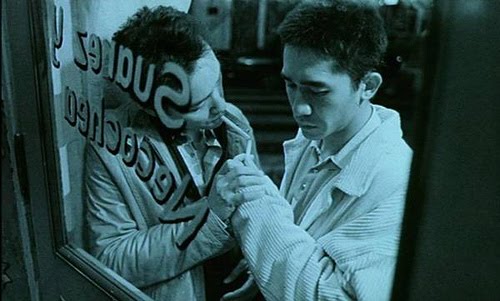
The Hong Kong film director Wong Kar Wai moves me in ways beyond expression. Sometimes when I find a director I like I steadily work through every film they have ever made, looting Fopp after long essay days or finding cheap copies on Amazon and waiting for their arrival. This is the way I am headed with Wong Kar Wai, a pattern of addiction and obsession. I can't stop thinking about the way Chan Marshall says the word 'sentimental' in My Blueberry Nights; the figure of Li-Zhen (In the Mood for Love) endlessly walking up and down stairs to fetch noodles for solitary dinners haunts me; the slow lyrical shot that sinks in to the Iguazu falls in Happy Together repeats in every moment of melancholia. Wong Kar Wai's films have got in to my soul.

I recently bought Happy Together, the story of two lovers travelling together in South America. Things fall apart, they do not get to the fabled Iguazu falls, the waterfall from their wonderfully tacky tourist lamp. Ho leaves for Buenos Aires and Lai finds work in a tango bar. The film shifts from its romantic black and white to the harsh colours of restaurant kitchens and cheap flats. The back cover describes it as a heady cocktail of sound and vision, the rhythms of Buenos Aires are combined with Frank Zappa's jazz, it is just all so astounding and it genuinely made me weep.

In The Mood for Love is undoubtedly his masterpiece; even my mother likes it and it is difficult to convince her to watch foreign films. Everything from Li-Zhen's elegant 60's dresses to the soundtrack (a combination of Nat King Cole, cantonese ballads and compositions) is perfectly poised and stunningly portrayed.


Chungking Express has so much heart I can forgive its confusing parallel narratives; Faye Wong falls in love with the heartbroken Tony Leung and visits his flat while he is out to clean, replace dead gold fish and listen to her sunny pop music. Then there is Takeshi Kaneshiro who buys out of date pineapple tins and eats them in the hope of solacing his love-lorn self. Wong Kar Wai dazzles me with light and colour and then slows movement as character and viewer fuse. If you have seen one of his films (or perhaps if you understand the technicalities of film) you will know what I mean. He has a style which is distinctive and lusciously beautiful. I could listen to soundtracks and watch the play of colours across my screen all day, it would soothe me.

The final thing you should know, is that I have a huge crush on Tony Leung...


Tuesday, 1 February 2011

Picasso looks at Degas

Degas Grand Arabesque, Second Time

Picasso, Running Woman

Long ago when I planned my trip to Barcelona it was the Museu Picasso's exhibition of Degas' influence on Picasso which solaced my solitary booking. The exhibition moved through the developments of Picasso suggesting connections through juxtaposition and reflection in Degas. Sometimes the echoes were subtle, at others they became potent homage as with Picasso's own sculptural arabesques. The images above show the skill of curatorial suggestion; Picasso applies the lyrical figures of Degas' dancers to his own sculptural work where material is heavier. Tactility rather than visual form is important within the creative process and yet a lyricism of form still exists, persists. Where humour was evident and Picasso's playful manipulation became tangible, this is when the exhibition was at its strongest for me.

In the 1870's Degas produced a number of monotypes; intimate studies of courtesans in their private rooms. The monotypes present Degas as voyeur, a private and unknown interest of the artist which fascinated Picasso. Between 1958 and 1960 Picasso acquired nine of the brothel monotypes for his private collection. He was curious about Degas's motivations for his secret prints and in March 1971 he began a series of 39 ecthings in which Degas appears as a client visiting a brothel.

Picasso's prostitute etchings are chaotic, gaudily decorated with whorls for nipples, patterned clothes and jewellery which reflect the patterning of their intimacy. There is an openness about these women who wear their nudity as a theatrical garment, and this contrasts with the marginal figure of Degas. He stands stiffly at the door looking in, at times approaching the women but their jouissant corpulence is always a threat. Picasso saw Degas as an alter-ego in his art, so there is a curious blurring of distinctions in these prints, is Picasso laughing at the reserved figure of Degas-verging-on-voyeur or is he questioning his own position within this brothel narrative?